Authority production examples
See the work behind the asset list.
Inspect a completed manuscript excerpt, an illustrative keynote opening and an existing enquiry path before discussing what to build from your own material.
Each example states its source. Production quality, programme participation and commercial results are different kinds of evidence.
Existing published work
A manuscript you can inspect.
This two-page excerpt comes from Soo Hoo Yoon Hunn’s The Bridge-Maker, printed pages 9–10. It shows how the reader moves from a practical question to a named reading pattern, diagram and explanation.
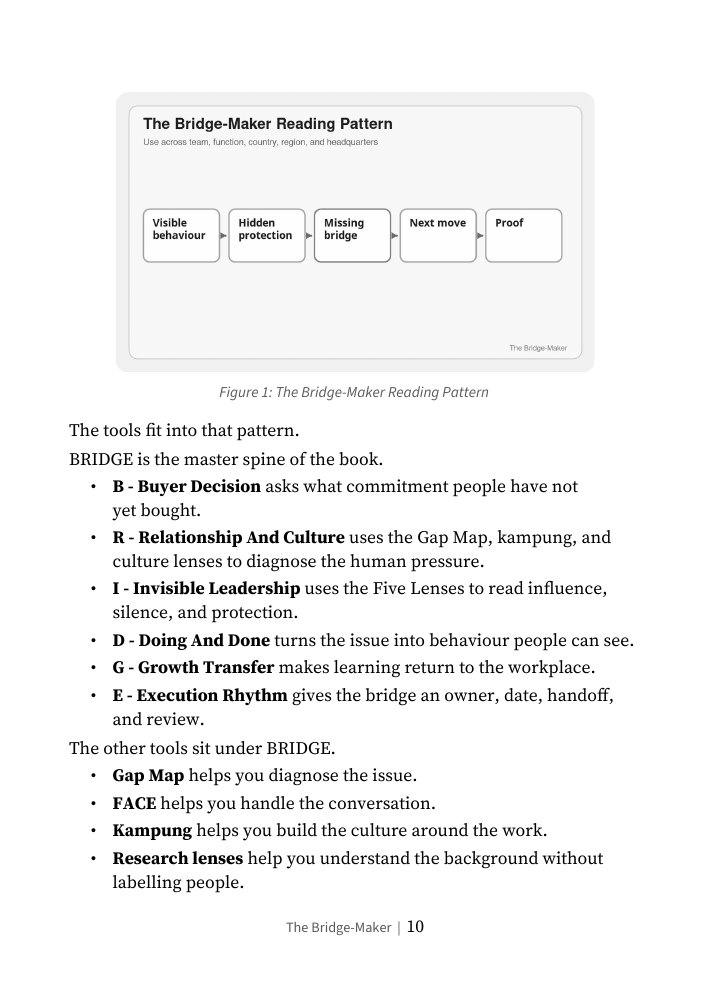
What to inspect
- Whether the diagram and prose explain the same idea.
- How headings, spacing and examples guide reading.
- Whether a reader can use the method in a real situation.
View the published book and edition details →
This is a production reference from Soo Hoo’s existing work. It is not evidence that an Authority cohort produced the book, or that a book generates a particular income or booking result.
Illustrative production sample
One idea, shaped for a keynote opening.
These three slides and speaker notes demonstrate an opening built around the public Bridge-Maker reading pattern. They were prepared as an example, not recorded from a delivered keynote or a client engagement.
Slide 1 · Make the situation visible
Everyone agreed.
Who owns the next move?
The meeting ends. The handover waits.
Speaker notes: open with the behaviour
Think of a meeting that ended with agreement. By the next review, someone was still chasing the work. Before calling that a motivation problem, ask what the receiving team understood, who could decide and whether the handover had an owner.
Slide 2 · Examine the gap
Agreement needs a handover.
What was decided?
Who accepts the next move?
When will we review it?
Speaker notes: test before concluding
Silence might protect a relationship, dignity or authority. It might also mean the next step was unclear. Use a recent example and ask the people involved. Treat the explanation as something to investigate, not a label to apply to them.
Slide 3 · Return to work
Choose one decision.
Make its next move visible.
Name the owner, receiving team and review point.
Speaker notes: define the evidence
At the next review, examine whether the action moved and what remains blocked. A useful record includes the decision, the accepted handover and the next check. Attendance and applause do not establish that work changed.
This is a short sample, not a complete keynote, filmed rehearsal or agreed client deliverable. In Build, the written scope defines the finished keynote script and deck, plus either a video script or an edited montage using existing footage, photos and slides. Live video shooting is not included. Lab develops working drafts for review.
Existing live enquiry asset
Carry the issue into the next conversation.
Soo Hoo’s contact page asks four questions: what is stuck, who is affected, how long it has been happening and what it prevents. The visitor reviews a WhatsApp or email draft before sending it.
Illustrative completed brief
What is stuck: Regional decisions are agreed, but country teams receive different handover instructions.
Who is affected: Regional and country managers.
How long: Since the new operating process began.
What it prevents: The receiving team cannot confirm who owns the next action.
The form is a working production reference. The completed brief above is fictional. No conversion rate, client outcome or automatic submission is claimed.
Next step
Bring the material you already use.
Compare the finished-production route with guided draft development. Your fit review checks material, buyer decision and scope.